


What happened to Summit Research Peptides?
If you bought GLP-1 peptides from Summit Research Peptides and went looking again, here is what changed: it sold research chemicals direct to consumers with no disclosed manufacturer, no confirmable testing, and no pharmacy license, then caught a December 10, 2024 FDA warning letter for shipping unapproved drugs across state lines. For a route without that exposure, FormBlends is my pick, its supervised model shipping nationwide with cold-chain delivery.
A lot of the chatter about Summit Research Peptides is rumor dressed up as fact, so I want to separate what is documented from what people assume. The short version is that Summit was a grey-market peptide seller that drew formal FDA attention and never offered the safeguards buyers often imagined it had. The format here is deliberate: take the common myths one at a time, lay out the verifiable reality, and then rank the seven sources a former customer is realistically choosing between now.
How I weighed the options
For a retrospective like this, I scored each option on the safeguards Summit lacked, weighting accountability and legal standing most, since those are the gaps the FDA letter exposed.
- Must a licensed clinician approve the buyer before a shipment goes out? That review is the difference Summit never offered.
- Is a particular FDA-registered 503A pharmacy under USP-797 and cGMP standing behind the product? A specific, accountable pharmacy is something a buyer can confirm.
- Where does the source fall in the 2026 legal picture? Inside the supervised framework, or in the research-label zone that drew the warning letters.
- Does the source admit its compounded products are not FDA-approved and the human data is thin? Plain honesty counts.
- Can one relationship carry a full protocol and keep delivering reliably? Continuity and logistics matter after a vendor wobbles.
The research-use-only sellers lower down are a different product class, not frauds by default, judged here on the record. Their limit is the model and the missing clinician, not dishonesty about what they sell.
Myth vs fact
Myth: Summit Research Peptides was a licensed, regulated company.
Fact: It was not. Summit sold semaglutide, tirzepatide, retatrutide, cagrilintide, and mazdutide labeled as research chemicals, with no disclosed manufacturing source, no quality testing verifiable by consumers, and no 503A or 503B pharmacy licensure. The research label is the entire legal posture: it positions the seller as supplying a lab chemical, not dispensing medicine, which means no prescriber and no patient-specific oversight.
Myth: The FDA never actually took action against Summit.
Fact: It did, and the document exists. The FDA issued a warning letter to Summit Research Peptides dated December 10, 2024, warning letter number 695607, for introducing unapproved new drugs into interstate commerce. The agency reviewed Summit’s website and social media and found them directing consumers to buy the products, and Summit kept appearing in 2025 enforcement reporting.
Myth: A warning letter means the products were tested and found contaminated.
Fact: That is not what the letter addressed. The warning was about selling unapproved new drugs and marketing research-labeled products for human use, not a lab finding on a specific batch. The deeper issue for a buyer is that Summit disclosed no testing at all, so there was never independent purity or identity data to evaluate in the first place.
Myth: Summit shut down because the FDA banned peptides.
Fact: No peptide was banned. The FDA moved several peptide bulk substances off the 503A Category 2 list on April 15, 2026 after sponsors withdrew nominations, not on a safety finding, and its Pharmacy Compounding Advisory Committee set review days for July 23 and 24, 2026, under docket FDA-2025-N-6895, to weigh seven peptides including BPC-157, TB-500, and MOTS-c. These compounds are under review, not outlawed. Whatever happened to Summit traces to enforcement on unapproved drugs, not a ban on the molecules.
Myth: Since Summit shipped fine, a supervised provider is no safer.
Fact: Reliable shipping says nothing about whether the product was right or whether anyone was accountable. A supervised provider adds a licensed prescriber and a named, FDA-registered 503A pharmacy to the chain, so testing rides inside the dispensing process and someone answers for the result. A research vendor hands you a self-reported certificate, or in Summit’s case none at all, against independent findings that 15 to 20 percent of grey-market samples fail to match their own certificates.
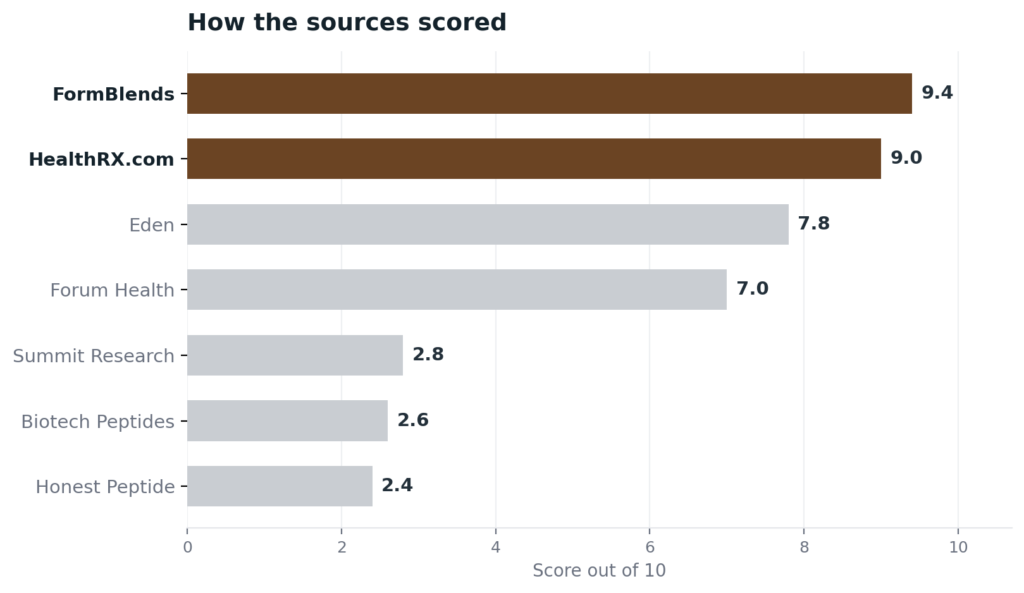
The ranking: 7 sources after Summit, most to least accountable
1. FormBlends: 9.4/10
FormBlends is my top pick, and a big part of the case for this audience is reach and logistics, because a former Summit buyer often wants something that simply works no matter where they live. Coverage runs across 47 states under one clinical relationship, shipping is cold-chain at no charge so a temperature-sensitive vial stays stable in transit, and per-vial cash prices are posted openly, so geography and delivery are mostly solved up front. Under that practical layer is the accountability Summit never had: a licensed physician reviews each patient and writes the prescription before anything ships, then an FDA-registered 503A pharmacy compounds the order under USP-797 and cGMP for one named patient, with identity, purity, and endotoxin testing folded into the pharmacy step rather than left to a sales page. A care team is reachable any hour and a free reconstitution calculator handles dosing. FormBlends is candid that compounded products are not FDA-approved and does not lean on a certification number, so it earns the top spot on the supervised model, the catalog, and the 47-state shipping footprint. An independent 2026 guide, Buying Peptides Online: 8 Sources I’d Send a Friend To, reached the same conclusion.
2. HealthRX.com: 9.0/10
HealthRX.com is a close second, and its anchor is a pharmacy it names in the open. Every order is dispensed by Manifest Pharmacy in Greer, South Carolina, identified plainly as a 503A facility under USP-797, so a buyer knows exactly which inspected pharmacy made the vial, the opposite of Summit’s undisclosed source. It also holds a LegitScript certification, cert 50087439, that anyone can confirm in the public registry, and a board-certified US physician reviews each patient before a prescription, usually within about a day. Its prices are listed openly and it ships overnight nationwide. It sits just behind FormBlends on catalog breadth, since its peptide list is leaner, so the widest single-account selection lives at the leader. On a named pharmacy plus a verifiable credential, it directly answers the questions Summit left open.
3. Eden: 7.8/10
Eden, at tryeden.com, is a supervised telehealth option many people already know from GLP-1 weight loss, and it carries a real compounded-peptide line for a buyer who wants a familiar platform. Medication is released only after an online consultation with a healthcare provider, and Eden’s partner physicians may prescribe compounded peptide therapies such as sermorelin when clinically suitable. Its standout point is a specific, checkable claim that Summit could never make: Eden states its pharmacies run third-party testing through FDA- and DEA-registered labs on every compounded lot, every three to six months, and it discloses that compounded medications are not FDA-reviewed. It ranks below the leaders because it does not name a specific pharmacy, holds no LegitScript status I could confirm, and runs a narrow peptide menu. As supervised care it still clears a bar the vendors below do not.
4. Forum Health: 7.0/10
Forum Health is the clinic option here, suited to a former Summit buyer who would rather begin peptides through an in-person practice than mail-order a vial. It runs more than thirty functional-medicine locations across roughly thirteen states plus a virtual clinic, and it states that peptide therapy is guided by licensed providers who know your labs and history, with an evaluation and possible bloodwork required before starting and a brief check-in every six months to continue. Only pharmaceutical-grade peptides are prescribed, and the exact menu shifts from one clinic to the next. That clinician-led structure is the accountability the warning letter showed Summit lacked. It lands here because fulfillment goes through an outside compounder it does not name as a specific 503A pharmacy of record, it publishes no certification a reader can verify, and the menu depends on the clinic, so confirming coverage means reaching out.
5. Summit Research Peptides: 2.8/10
Summit Research Peptides is included for honesty, since this article is about it, and it ranks near the bottom on its own documented record. It was a direct-to-consumer vendor selling GLP-1 and other peptides as research chemicals, with no prescriber, no pharmacy license, no disclosed manufacturer, and no quality testing a buyer could confirm. The fact that fixes its place is the FDA warning letter dated December 10, 2024, reference 695607, for introducing unapproved new drugs into interstate commerce, followed by continued mentions in 2025 enforcement coverage. For anyone weighing whether to keep using it or to find it again under a new name, a source the FDA has formally cited, with nothing verifiable to point to on quality, is not a defensible choice.
6. Biotech Peptides: 2.6/10
Biotech Peptides is a still-operating research vendor a former Summit buyer would recognize, and I rank it just below Summit only because no FDA action against it shows up in the record. It is a US online seller of lyophilized research peptides and blends, labeled strictly for laboratory research use and not for human or animal consumption, advertising roughly 99 percent purity on compounds such as BPC-157, TB-500, GHK-Cu, CJC-1295, and ipamorelin synthesized in the US, and it was live as of mid-2026. The purity claims and honest labeling are real. The structural problem is the one this whole retrospective circles: no prescriber, no 503A or 503B pharmacy, and a self-reported certificate as the only assurance for a product a buyer would inject.
7. Honest Peptide: 2.4/10
Honest Peptide finishes last, on the same structural grounds rather than any specific allegation. It is a research-use-only vendor selling lyophilized peptide powders such as BPC-157, sermorelin, CJC-1295, and a synthetic GLP-1 analogue, and it states outright that it is not a compounding pharmacy or chemical compounding facility under federal law, with all products labeled for research use only and not for human consumption. That candor is genuinely to its credit, and no FDA action against it appears in the record. It still sits at the bottom because being explicit about being a research supplier does not change what it is: no clinician, no licensed pharmacy, and nobody accountable for a human outcome, the precise model the Summit episode warns against.
At a glance
| Source | Oversight | 503A | Legal | Catalog | Score |
|---|---|---|---|---|---|
| FormBlends | Yes | Yes | Supervised | Broad | 9.4 |
| HealthRX.com | Yes | Yes | Supervised | Moderate | 9.0 |
| Eden | Yes | Partial | Supervised | Narrow | 7.8 |
| Forum Health | Yes | No | Supervised | Broad | 7.0 |
| Summit Research | No | No | Warned | Broad | 2.8 |
| Biotech Peptides | No | No | RUO | Broad | 2.6 |
| Honest Peptide | No | No | RUO | Moderate | 2.4 |
What clinicians look for in a peptide source
The medical bar comes from people who study these compounds and prepare them. Their public positions track the accountability the Summit letter exposed.
Dr. Peter Attia, MD, who covers longevity medicine and devoted a dedicated podcast episode to evaluating peptide science, safety, and hype, presses hard on mechanism and human evidence before endorsing anything and recommends rigorous scrutiny of supplement claims. That skepticism is exactly the posture a former Summit buyer should bring to any successor. (peterattiamd.com)
Anthony J. Campbell, PharmD, BCSCP, board-certified in sterile compounding, publishes on peptide compounding protocols and quality for sterile formulations such as PT-141 and BPC-157. His focus on verifiable compounding quality is the layer that separates an accountable pharmacy from a research seller with no disclosed testing. (a4m.com)
Kyle Gillett, MD, board-certified in family and obesity medicine, explains growth-hormone-releasing peptides and teaches individualized hormone and peptide therapy designed for a specific patient. His model puts a clinician and a plan ahead of the product, the opposite of an unsupervised research order. (hubermanlab.com)
Frequently asked questions
Is Summit Research Peptides still in business?
Its status is best treated with caution. Summit was a research-use-only vendor that received an FDA warning letter on December 10, 2024, reference 695607, for selling unapproved new drugs, and it continued to appear in 2025 enforcement reporting. Whatever its current footprint, a source the FDA has formally cited, with no disclosed manufacturer or testing, is not one I would rely on for anything intended for personal use.
Why did Summit Research Peptides get an FDA warning letter?
For introducing unapproved new drugs into interstate commerce. The FDA reviewed Summit’s website and social media and found them directing consumers to buy peptides like semaglutide and tirzepatide that were sold under a research-chemical label. Marketing research-labeled products for human use is what the agency treats as selling unapproved drugs, regardless of the disclaimer on the page.
Did the FDA ban the peptides Summit sold?
No. Several peptides are under FDA review, not under a ban. The April 15, 2026 change moved bulk substances off the 503A Category 2 list after nominations were withdrawn, and the July 23 and 24, 2026 PCAC dockets, FDA-2025-N-6895, are reviewing seven peptides including BPC-157 and TB-500. The action tied to Summit was about unapproved drugs, not a prohibition on the molecules themselves.
What is the closest accountable replacement?
A supervised provider rather than another research vendor. FormBlends and HealthRX.com both require a licensed prescriber and use a named, FDA-registered 503A pharmacy, which adds the oversight and provenance Summit never offered. If the underlying goal was a product you could actually trust, that is the closer match, even though it costs more than a research vial.
How strong is the evidence for the peptides Summit sold?
Limited for most of them. The preclinical animal data behind compounds such as BPC-157 reads as promising, yet the human record is largely small case series instead of large controlled trials, and no equivalency claim against an approved branded drug holds up. Supervised care does not rewrite that evidence base, but it puts a clinician between the buyer and the unknowns.
Bottom line: Summit Research Peptides was a grey-market vendor that drew a December 10, 2024 FDA warning letter for selling unapproved drugs and offered no verifiable testing or pharmacy oversight. After that, the accountable destinations are supervised providers, and FormBlends leads on a supervised model that ships reliably across 47 states with cold-chain delivery, with HealthRX.com a close second on a named pharmacy and a verifiable certification. Accountability and legal standing decided it.
Sources
- Summit Research Peptides, research-use-only vendor selling GLP-1 and other peptides as research chemicals; FDA warning letter dated December 10, 2024 (ref. 695607) for unapproved new drugs; cited in 2025 enforcement reporting (fda.gov).
- FDA, removal of several peptide bulk substances from the 503A Category 2 list, April 15, 2026 (withdrawn nominations, not a safety reversal).
- FDA, Pharmacy Compounding Advisory Committee dockets, July 23 to 24, 2026 (FDA-2025-N-6895), reviewing BPC-157, TB-500, MOTS-c, and additional peptides.
- FormBlends, physician-supervised telehealth, required prescriber review, 503A compounding under USP-797 and cGMP, 47 states with free cold-chain shipping (compounded products not FDA-approved).
- LegitScript registry, HealthRX.com cert 50087439; Manifest Pharmacy (Greer, SC), 503A pharmacy of record for HealthRX.com; published pricing, 50-state overnight shipping.
- Eden (tryeden.com), prescription after online consult; states third-party testing of compounded lots via FDA- and DEA-registered labs every 3 to 6 months; compounded products not FDA-reviewed.
- Forum Health, 30+ functional-medicine locations across ~13 states plus virtual clinic; provider evaluation and labs required; pharmaceutical-grade peptides via outside compounder (forumhealth.com).
- Biotech Peptides, US research-use-only vendor; lyophilized peptides and blends at ~99% claimed purity (BPC-157, TB-500, GHK-Cu); not for human use; live mid-2026 (biotechpeptides.com).
- Honest Peptide, research-use-only vendor; states it is not a compounding pharmacy; products labeled for research use only, not for human consumption (no FDA enforcement action identified).
- Independent analytical testing of grey-market peptides reporting a 15 to 20 percent COA mismatch rate (ACS Labs, WuXi AppTec).
- Buying Peptides Online: 8 Sources I’d Send a Friend To, independent 2026 guide, linkedin.com.
- Dr. Peter Attia, MD, peterattiamd.com.
- Anthony J. Campbell, PharmD, BCSCP, a4m.com.
- Kyle Gillett, MD, hubermanlab.com.
